
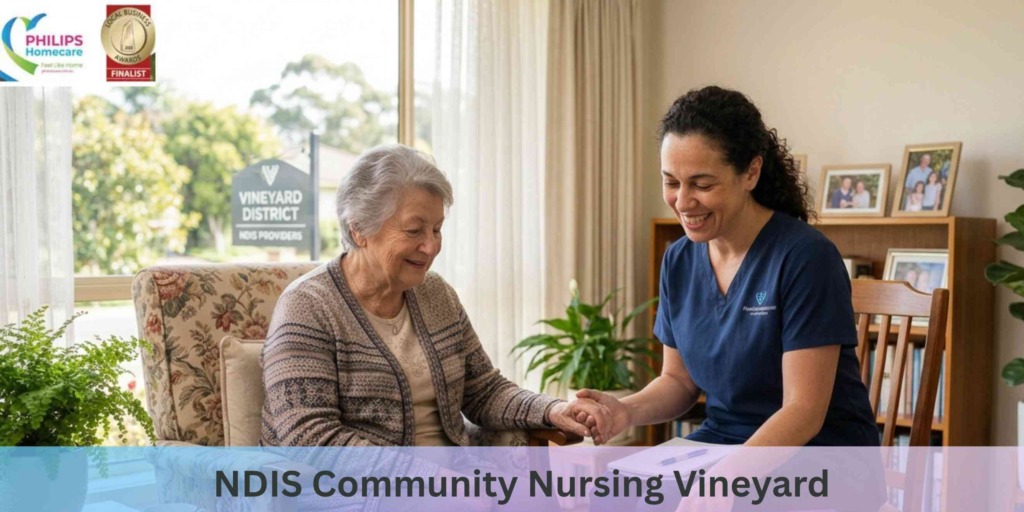
NDIS community nursing Vineyard is clinical care from qualified nurse who visits you at home. It covers tasks such as catheter care, wound dressing, continence support and diabetes management. The NDIS can pay for it when the need comes from your disability and nursing is included in your plan. To check whether P Homecare can visit your address, call 1800 571 955.
What a NDIS Community Nursing Vineyard actually does
A community nurse brings clinical care to you, so health tasks no longer depend on a clinic appointment or a long trip. Typical NDIS visits in Vineyard include:
- Changing and managing urinary catheters
- Dressing wounds and treating pressure injuries
- Blood glucose checks and insulin support for diabetes
- Stoma and bowel care, along with continence assessments
- Reviewing medications and spotting side effects early
- Coaching family members and support workers in safe routines
Some of this work can only be done by a nurse. Catheter changes and complex wound care are the clearest examples. Routine tasks can sometimes pass to a trained support worker, but only after a nurse has assessed you and written a care plan. Our overview of community nursing in Australia covers the basics.
Why Vineyard needs a different approach
Vineyard is a semi-rural suburb on the north-western edge of Sydney, close to Windsor, Riverstone and Box Hill. Homes are spread out and travel times between clients are longer than in denser suburbs. For nursing, that matters. A provider that plans routes carefully is more likely to arrive when expected, and punctual visits are important when a dressing or catheter change has a set schedule.
Ask any provider how it handles travel and cover. Find out who steps in if your regular nurse is unwell and how far ahead visits are booked.
Who it helps
Community nursing suits participants whose disability brings continuing health needs. That includes people living with an indwelling catheter, diabetes, a spinal injury, a chronic wound or complex bowel needs. It also helps people returning home after a hospital stay, and families who want the confidence of regular clinical check-ins.
How the NDIS funds nursing
The NDIS funds supports listed in your plan rather than a particular condition. It describes three levels of disability-related health support. The level depends on how many health areas need nurse oversight, from up to two at the low level to four or more at the high level. Funding can include the cost of a nurse training a support worker for delegated tasks.
Check your plan first, or ask your support coordinator. Price limits sit in the NDIS pricing arrangements, so a provider’s written quote should stay within them.
Choosing a provider: a short checklist
- Registration for nursing. Search the NDIS Commission provider register and look for community nursing care among the approved registration groups.
- Qualified nurses. Registered and enrolled nurses appear on the AHPRA register.
- Complex task training. Ask how staff are trained and assessed for wound care and catheter management.
- Reporting. Check who tells your GP or coordinator when your condition changes.
- Transparent pricing. Request a written quote, including any travel charges, before the first visit.
Community nursing is for ongoing care and does not replace emergency help. Fever, a blocked catheter or fast-spreading redness around a wound needs a GP or emergency department, and 000 in an emergency.
How P Homecare helps
P Homecare is a registered NDIS provider working across Western Sydney, including nearby Rouse Hill and Box Hill and Blacktown. Our community nursing care includes catheter care, wound care, continence support and medication management. When a participant needs more than visits, we can add 24-hour NDIS support or arrange Supported Independent Living.
We begin by listening. A nurse builds the care plan around your health needs, your daily routine and the goals in your plan, and reviews it as things change.
Getting started
- Look at your NDIS plan, or ask your coordinator whether nursing is funded.
- Call 1800 571 955 or submit the client intake form.
- Talk through your needs with our team and agree on a care plan.
- Start home visits, with regular reviews.
Already receiving care elsewhere? You can change providers at any time, and we will help with the paperwork. Questions first? Contact our team.
NDIS community nursing in Vineyard is clinical care from qualified nurse who visits you at home. It covers tasks such as catheter care, wound dressing, continence support and diabetes management. The NDIS can pay for it when the need comes from your disability and nursing is included in your plan. To check whether P Homecare can visit your address, call 1800 571 955.
It is clinical care from a qualified nurse, given at home or in the community, to NDIS participants whose health needs are linked to their disability. Examples include catheter care, wound care and diabetes support.
Home visits are possible in Vineyard and nearby north-west Sydney suburbs, depending on your address and care needs. Call 1800 571 955 to confirm availability.
It can, if wound care is a disability-related health need and the support appears in your plan. Complex wound care is carried out by a nurse.
Clinical tasks such as catheter changes and complex wound care need a nurse. A support worker can take on certain routine health tasks once a nurse has trained them and documented a plan.
Search the NDIS Commission register for the provider and look for community nursing care among its registration groups. You can also search for individual nurses on the AHPRA register.